Bart Schutz – Master of Online Persuasion
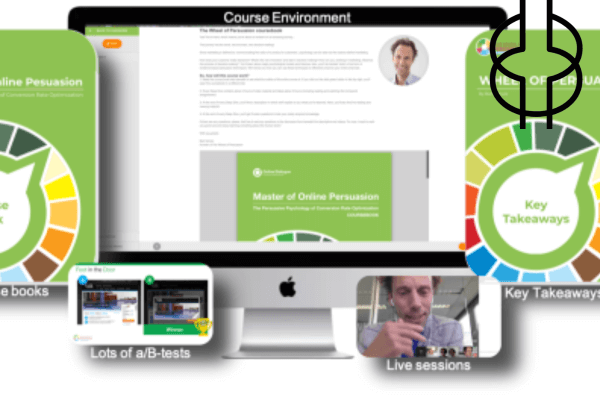
Get the Master of Online Persuasion Course for $699 $14
The Size is 5.38 GB and is Released in 2025


Meet Bart Schutz, your guide to ethical, high-converting digital persuasion. You’ll learn how he blends System 1/2 psychology with urgency, scarcity, and friction reduction to boost action. His 18.5-hour course gives DIY tactics for attention, motivation, and memory—each tied to measurable outcomes. Keynotes and workshops turn science into practical playbooks with A/B-proven impact. Ethics stay central, backed by a code and analytics for unintended effects. The Wheel of Persuasion makes it all actionable, and there’s more ahead.
The Science Behind Digital Persuasion
While clicks feel spontaneous, digital persuasion works by steering both your fast, intuitive System 1 and your slower, analytical System 2. You react to urgency, scarcity, and social cues in a blink, then justify the choice afterward. When you simplify steps and reduce friction, you raise perceived ability, so you’re more likely to act on a call to action, especially in high-stakes moments like donating.
You also wrestle with delayed gratification. The Marshmallow test shows why self-control predicts long-term outcomes. Design that supports patience—clear benefits now, bigger rewards later—helps you choose better without cognitive strain. Brands like Booking.com cue System 1 with timers and nudges, narrowing options to streamline choices and push you toward decisive clicks, while leaving just enough clarity for System 2 to agree.
To know what truly works, you test. You run experiments with adequate statistical power—typically 80%—so you detect real effects, avoid false wins, and scale only proven persuasion.
Master Course in Online Persuasion & Experience Design
Even if you’ve shipped countless campaigns, this Master Course in Online Persuasion & Experience Design gives you a sharper, evidence-based playbook. You’ll work through 18.5 hours of DIY video lectures, a coursebook, and downloadable PDFs that decode the psychology behind user behavior and decision-making. You won’t just learn theories—you’ll apply psychological tactics that influence conscious and unconscious processes to lift engagement across websites, apps, and funnels.
You’ll practice concrete skills: grabbing attention, motivating purchases, and shaping memory to improve recall and satisfaction. Each tactic connects to measurable outcomes, helping you optimize journeys, messages, and UI choices with precision.
Ethics sit at the core. You’ll learn how to embed transparent, integrity-first practices inside your organization so persuasion serves users and brand trust. Assessments and a final exam reinforce mastery and application, while student feedback underscores real-world effectiveness. By the end, you’ll design experiences that convert responsibly—and repeatedly.
Related Posts



Keynotes, Workshops, and Real-World Impact
Because Bart Schutz turns research into action, his keynotes and workshops leave you with practical playbooks—not just inspiration. You don’t just hear about digital consumer behavior; you see how to use it. He blends digital data, experimentation, and company culture to help you design persuasive communication that actually moves the needle.
Expect clear frameworks, live examples, and evidence from randomized controlled trials. You’ll practice applying behavioral science to your own funnels, messages, and product flows, then pressure-test ideas with data. That’s why participants consistently rate his sessions highly and leave with strategies they can deploy the next day.
You’ll also learn how to structure experiments that isolate causal impact, interpret results, and scale proven tactics. Teams report sharper understanding of persuasion mechanics, leading to higher engagement rates and improved marketing effectiveness. If you want sessions that change how you work—grounded, measurable, and immediately usable—his keynotes and workshops deliver exactly that.
Ethics at the Core of Behavioral Design
You’ve seen how Bart turns behavioral science into measurable action; the same rigor must guide where you draw the line. Ethical application isn’t a nice-to-have—it prevents manipulation and protects the integrity of every interaction. You’re influencing behavior; that demands accountability.
Start by codifying your stance. Create a Code of Ethics for digital persuasion and embed it into hiring, onboarding, experiments, and performance reviews. Define what’s acceptable, what’s not, and why. Make values explicit so teams can evaluate tactics against real-world impact on user behavior.
Use data to check yourself. Integrate ethical evaluations into your analytics and experimentation: measure unintended consequences, segment impacts on vulnerable users, and set stop-loss rules for harm. If a lift comes at the cost of trust, reject it.
Promote ethical awareness daily. When you champion integrity, you elevate employee pride and satisfaction, and you earn consumer trust and loyalty. Persuasion wins sustain when people feel respected.
The Wheel of Persuasion: Tactics, Proof, and Application
Precision meets persuasion in Bart Schutz’s Wheel of Persuasion—a rigorously curated library of tactics that merge behavioral science with practical execution. You get a thorough system: academic theory distilled into clear patterns, paired with actionable methods to improve journeys, messaging, and monetization. Each tactic anchors to psychological drivers—attention, motivation, friction—so you can diagnose barriers and design targeted interventions.
You don’t have to take it on faith. The Wheel embeds digital proof through A/B tests that quantify uplift in engagement and conversion. You see what works, for whom, and under which conditions, then iterate with confidence. Schutz’s expertise as a leading consumer psychologist ties the pieces together, giving you a framework to translate cognitive principles into measurable outcomes.
Crucially, persuasion stays ethical. Use the Wheel to formalize a Code of Ethics, set guardrails, and audit experiments. When you apply tactics responsibly, you optimize experiences, respect autonomy, and scale conversion the right way.
Frequently Asked Questions
How Did Bart Schutz Begin His Career in Behavioral Science and Marketing?
He began by studying psychology, then applied behavioral science to marketing problems early in his career. You see him move from academic insights to real-world experimentation, focusing on conversion optimization and user behavior. He co-founded a consultancy, built A/B testing programs, and translated cognitive biases into practical tactics. You’d notice he bridges science and commerce, mentors teams, speaks at conferences, and publishes frameworks that help you design persuasive, data-driven experiences.
What Industries Has Bart Worked With Beyond E-Commerce?
You’ll find he’s ventured far beyond e‑commerce—into finance, telecom, travel, media, healthcare, and public sector projects. Picture a tidal wave of experiments crashing across banks, insurers, airlines, and hospitals as he tests human behavior at scale. You see him tweak onboarding for telcos, pricing for airlines, messaging for charities, and decision flows for healthcare portals. He also nudges media subscriptions and energizes government services, applying behavioral insights wherever choices multiply.
How Does Bart Measure Long-Term Brand Effects of Persuasion?
You track long-term brand effects by combining controlled experiments with longitudinal metrics. You run geo or cohort holdouts, measure brand lift surveys, track aided/unaided awareness, preference, and NPS, and model incremental impact via MMM and causal inference. You link persuasion tactics to mental availability by monitoring search share, direct traffic, repeat rate, and pricing power. You validate memory encoding with recognition tests and guarantee durability by re-measuring effects quarterly against control baselines.
What Tools and Platforms Does Bart Prefer for Experimentation?
You’ll reach for Optimizely or VWO to spin up crisp A/B and multivariate tests, like flipping switches in a control room. You’ll pair Google Optimize alternatives with Google Analytics 4, BigQuery, and Looker to read the dials. You’ll sketch hypotheses in Airtable or Notion, manage backlogs in Jira, and push iterations via feature flags in LaunchDarkly. For qualitative texture, you’ll weave Hotjar session maps and user interviews into the experiment tapestry.
How Can Startups Engage Bart for Tailored Consulting?
You can engage Bart by contacting his consultancy directly, outlining your growth goals, target metrics, and decision-making cadence. Share your data stack, traffic volumes, experimentation history, and key user journeys. Propose an initial discovery workshop, then a pilot sprint with clear hypotheses, success criteria, and governance. Ask for a tailored scope: strategy, research, experiment design, and coaching. Request example case results, team fit, availability, pricing options, and NDAs to kick off quickly.
Conclusion
You’re a sailor steering through choppy digital seas. Bart Schutz hands you a compass—behavioral science—and a sail—the Wheel of Persuasion. You tack with ethics as your North Star, trimming tactics to the winds of context. In master courses and keynotes, you learn to read currents, not force them. You chart experiences that respect minds, not exploit them. And as your ship cuts cleaner wakes, you realize persuasion’s true voyage: guiding others safely while honoring their freedom to choose.